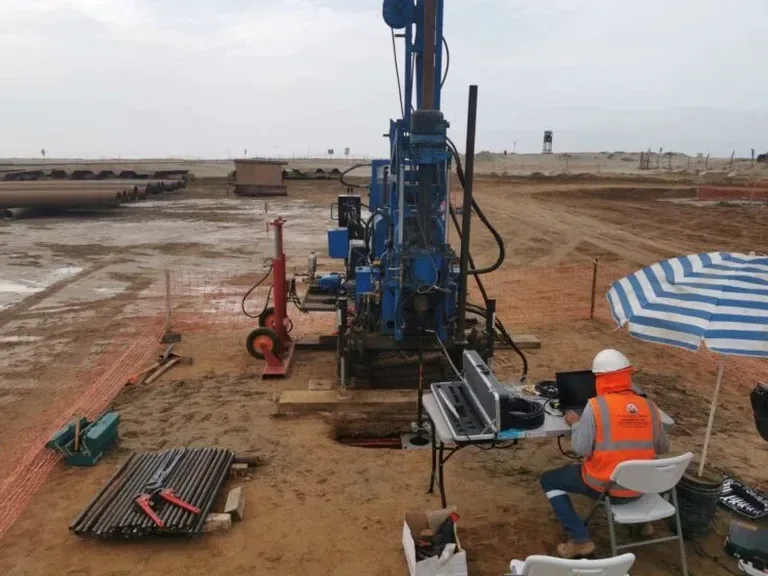
The Spokane area sits on a complex foundation of glacial outburst flood deposits, ancient lake sediments from Glacial Lake Missoula, and basalt bedrock, creating a subsurface environment where soil layers can change dramatically within a few hundred feet. In our experience working across the city, from the granular soils near the Spokane River to the silt-rich terraces of the South Hill, traditional drilling methods often fail to capture the subtle transitions between loose, potentially liquefiable zones and dense bearing strata. A cone penetration test provides a continuous, high-resolution profile of soil behavior without the disturbance that sampling introduces, which is particularly valuable when characterizing the interbedded sands and silts so common here. For projects requiring deep foundation design or seismic analysis, we frequently pair the CPT data with liquefaction assessment to evaluate the cyclic resistance of saturated deposits mapped across the Spokane Valley, ensuring compliance with the International Building Code and local amendments.
In Spokane's glacial deposits, a single CPT sounding can replace multiple exploratory borings by delivering continuous stratigraphy and pore pressure data that reveal the true complexity of the subsurface.
How we work
Local ground factors
The contrast between the well-drained gravels of the North Side and the thick lacustrine silts underlying sections of the University District illustrates the risk of relying on sparse, low-resolution data. In the North Side, a few SPT borings might suggest competent ground across the entire parcel, yet we have encountered isolated pockets of soft clay that went undetected until a CPT trace revealed a sharp drop in tip resistance and a corresponding spike in pore pressure. Over on the South Hill, the opposite hazard exists: stiff silt that gives decent blow counts can mask a high sensitivity to disturbance, where remolding during excavation or pile driving collapses the soil structure and triggers unexpected settlements. Without the continuous piezocone record, these thin problematic seams are easily missed, leaving the design based on an overly optimistic soil model that fails to account for the real vertical variability Spokane's glacial history created.
Applicable standards
ASTM D5778 – Standard Test Method for Electronic Friction Cone and Piezocone Penetration Testing of Soils, IBC 2021 (International Building Code) – Chapters 16 and 18 on structural design and soils, ASCE 7-22 – Minimum Design Loads and Associated Criteria for Buildings and Other Structures, WSDOT Standard Specifications Section 203 – Roadway Excavation and Embankment (applicable to transportation projects)
Associated technical services
Seismic Piezocone with Downhole Shear Wave Velocity
At select depths during the CPT push, a seismic source at the surface generates a shear wave that is recorded by a geophone in the cone, providing a direct measurement of Vs that is essential for Site Class determination per ASCE 7. We use this data to refine the small-strain stiffness profile across Spokane's varied deposits.
CPT-Based Pile and Shallow Foundation Design
Utilizing the direct correlations between cone resistance and unit bearing capacity developed by Eslami and Fellenius, we translate the CPT profile into axial pile capacity and spread footing settlement predictions, calibrated specifically for the coarse-grained flood deposits and fine-grained lake sediments encountered locally.
Typical parameters
Quick answers
How much does a CPT test cost in Spokane?
For investigations within the Spokane metropolitan area, a CPT sounding typically ranges from US$180 to US$240 per hour of rig time, which includes the operator, the piezocone equipment, and the data acquisition system. Mobilization to more distant sites like Cheney or Deer Park adds a transport charge that we quote based on round-trip mileage and the number of sounding locations. A single-day program with two to three soundings to 60 feet depth generally falls between US$2,800 and US$4,200 total, though the final figure depends on access conditions and whether seismic add-ons are required.
What depth can a CPT rig reach in Spokane's soils?
The achievable depth depends heavily on the soil conditions at the specific site. In the dense gravels and cobbles of the Spokane Valley outwash plain, refusal can occur at relatively shallow depths, sometimes as little as 15 to 25 feet, when the cone encounters particles larger than the cone diameter. In the finer-grained lacustrine silts and clays of the city center and South Hill, we routinely reach 80 to 100 feet before reaching practical refusal or the thrust capacity of the 20-ton equipment. We always include a pre-drilling contingency in our proposals for sites where gravel layers are anticipated.
Is a CPT test better than SPT drilling for my project?
The two methods serve complementary roles rather than one being universally superior. The CPT delivers a continuous, operator-independent record of soil response that is excellent for stratigraphic profiling, liquefaction analysis, and direct foundation design correlations. The SPT, on the other hand, provides a disturbed soil sample that a geotechnical engineer can visually classify and use for laboratory index tests. For projects on the complex glacial sequences in Spokane, we often recommend a program where CPT soundings provide the primary stratigraphic framework, and a smaller number of SPT borings supply material for laboratory verification of the soil behavior types interpreted from the cone data.
Can you perform CPT testing in areas with high groundwater in Spokane?
Yes, and in fact the piezocone is specifically designed to operate in saturated conditions and measure the pore water pressure response during penetration. Much of the Spokane Valley and the areas adjacent to the Spokane River have groundwater within 10 to 15 feet of the surface, and the CPT is the preferred tool here because it captures the exact depth of the water table and the hydrostatic profile without requiring a separate monitoring well installation. The continuous pore pressure record also allows us to identify artesian conditions or perched water zones that could complicate excavation and basement construction.
How long does it take to get the CPT results and report?
The raw data plots—tip resistance, sleeve friction, pore pressure, and friction ratio versus depth—are available immediately upon completion of each sounding, and we provide these to the site engineer before the rig demobilizes. A full interpreted report, which includes soil behavior type classification using the Robertson chart system, normalized soil parameters, and preliminary foundation recommendations, is typically delivered within five to seven business days. For time-sensitive projects, we can expedite the interpretive report to a 48-hour turnaround when coordinated in advance with our Spokane-based engineering team.