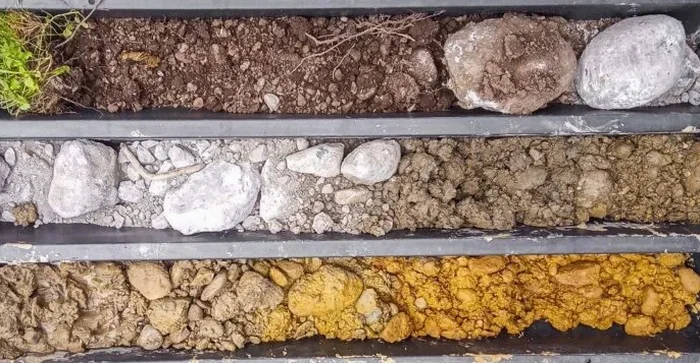
A recent commercial development on the north bank of the Spokane River required verification of undocumented fill over glacial outwash before footing design could proceed. The general contractor had auger refusal at 4 feet in three borings – turned out to be buried basalt rubble from the 1900s rail yard expansion. Our team mobilized a tracked excavator the next morning, opened four exploratory test pits to 12-foot depth, and logged the stratigraphy directly from the pit wall. Spokane’s geology shifts abruptly across short distances: Missoula Flood deposits, basalt flows, and lacustrine silts all coexist within the same township. Test pit excavation gives the clearest possible picture of these transitions, letting the geotechnical engineer observe soil structure, moisture conditions, and cobble content without the disturbance inherent in split-spoon sampling. When we combine visual logging with bulk sampling for grain-size analysis and Atterberg limits, the resulting geotechnical model carries the weight of direct observation – something no remote sensing method can replicate in the variable ground conditions of eastern Washington.
Direct observation of soil structure in a test pit wall reveals depositional history that no drilling log can capture.
How we work
Local ground factors
A long-reach excavator bucket cutting through Spokane’s dry summer topsoil looks routine until the operator hits a saturated silt lens at 9 feet and the pit wall starts sloughing within seconds. Unstable excavation sidewalls are the primary hazard during test pit operations in this region, driven by perched groundwater in glacial lake deposits and the low cohesion of Missoula Flood slackwater silts. OSHA classifies these materials as Type C soil, requiring a 1.5:1 slope or equivalent shoring – and in urban Spokane where right-of-way constraints limit benching space, that often means a tighter excavation plan with engineered shielding. The competent person on site must recognize raveling, tension cracks at the surface, and changes in seepage pattern before they become a collapse. Confined-space protocols activate when pit depth exceeds 4 feet with limited egress; atmospheric testing is mandatory if the excavation encounters organic fill or suspected contaminated soil from legacy industrial parcels near the BNSF rail corridor. No technician enters until the competent person signs off on the entry permit.
Applicable standards
IBC 2021 Section 1803 – Geotechnical Investigations, ASCE 7-22 Chapter 11 – Seismic Site Classification, ASTM D2487-17e1 – Classification of Soils for Engineering Purposes (USCS), ASTM D2488-17 – Description and Identification of Soils (Visual-Manual Procedure), OSHA 29 CFR 1926 Subpart P – Excavations
Associated technical services
In-Situ Density Testing (Sand Cone)
Backfill compaction verification using ASTM D1556 sand cone method, performed directly on compacted lifts in the test pit after backfill placement. Essential for retaining wall backfill acceptance and utility trench closeout in Spokane city right-of-way permits.
Atterberg Limits and Grain-Size Distribution
Laboratory classification on bulk samples collected from the test pit wall. Plasticity index and gradation curves determine USCS group symbol, which feeds directly into bearing capacity calculations and seismic site class determination per ASCE 7.
Typical parameters
Quick answers
What does an exploratory test pit cost in the Spokane area?
Test pit excavation and logging in Spokane County generally ranges between US$460 and US$880 per pit, depending on depth, access constraints, and whether shoring or groundwater control is needed. That figure covers mobilization, excavation, competent person inspection, visual logging, photographic documentation, and backfill compaction. Laboratory testing on collected samples is priced separately.
How deep can you excavate a test pit in Spokane soils?
Practical depth in Spokane’s glacial and alluvial soils is 10 to 14 feet with a medium excavator. Depth may be limited by groundwater – particularly in the Spokane Valley aquifer corridor where static water can appear as shallow as 6 feet during spring – or by OSHA Type C soil slope requirements when space is tight. Deeper investigation typically transitions to SPT drilling or CPT sounding.
Do you need a permit for a test pit in the city of Spokane?
Yes. Excavation within Spokane city limits requires a right-of-way permit if the pit is in the public street or sidewalk, and utility locates through Washington 811 are mandatory regardless of location. For private property, the geotechnical investigation itself does not require a building permit, but the project’s civil plans must include the test pit data in the geotechnical report submitted for permit review.