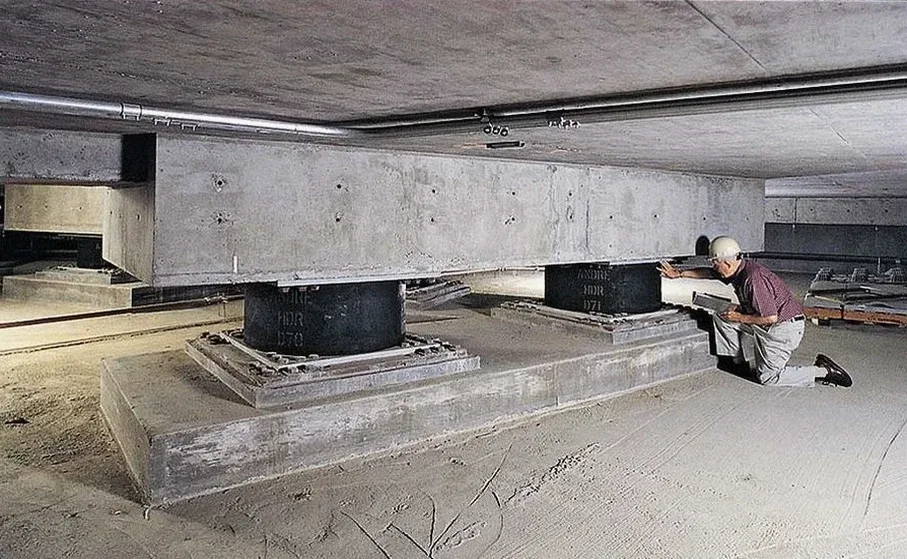
A common mistake we see in the Spokane region is specifying fixed-base moment frames without checking whether a site sits on the glaciolacustrine silts that blanket the Rathdrum Prairie aquifer. These deposits can amplify ground motion in ways that push story drifts past code limits, even when the design spectra look conservative on paper. Base isolation seismic design decouples the superstructure from that amplified motion, but it only works when the isolator properties are tuned to the actual shear-wave velocities measured on site. Our laboratory runs the advanced dynamic soil tests that feed those nonlinear isolator models, from resonant column to cyclic direct simple shear, so the isolation system performs as intended when the next Spokane fault event occurs.
An isolation system is only as reliable as the shear modulus degradation curve it stands on — and that curve comes from the lab.
How we work
Local ground factors
Spokane lies within 50 kilometers of the Spokane Fault, a north-northeast-striking structure that last ruptured approximately 13,000 years ago and remains capable of generating a magnitude 6.5 or larger event. The city sits at an elevation of roughly 1,900 feet, with much of the downtown built on Pleistocene outburst flood deposits that vary from open-framework gravel to overconsolidated silt within a single city block. This lateral heterogeneity creates differential ground motion that fixed-base buildings handle poorly but that a well-designed isolation plane can accommodate. The IBC classifies Spokane as Seismic Design Category D, which triggers mandatory isolation peer review — a process we support with defensible lab data and site-specific response spectra rather than generic default curves.
Watch the video
Applicable standards
ASCE/SEI 7-22 Minimum Design Loads and Associated Criteria for Buildings and Other Structures (Chapter 17), IBC 2021 Section 1705.13 — Seismic Isolation, ASTM D4015-21 — Standard Test Methods for Modulus and Damping of Soils by Resonant-Column Method, ASTM D6528-17 — Standard Test Method for Consolidated Undrained Direct Simple Shear Testing of Fine-Grained Soils, AASHTO T 297 — Standard Method of Test for Consolidated Undrained Direct Simple Shear
Associated technical services
Site-specific ground motion and site class analysis
We run MASW or downhole seismic surveys to establish Vs30 and site class per ASCE 7 Chapter 20, then develop site-specific response spectra and acceleration time histories scaled to the project's target risk category and return period.
Dynamic soil property testing for isolator modeling
Resonant column, cyclic direct simple shear, and cyclic triaxial programs that deliver the G/Gmax reduction curves and damping ratios required for nonlinear isolator analysis in software such as SAP2000 or ETABS.
Typical parameters
Quick answers
What does base isolation seismic design typically cost for a mid-rise project in Spokane?
For a mid-rise commercial building in the Spokane area, the full geotechnical characterization package that feeds the isolation design — including field velocity profiling, resonant column, and cyclic DSS testing — generally falls between US$4,150 and US$7,160, depending on the number of borings and the strain levels required by the structural engineer.
Which isolator types does your lab support with dynamic soil data?
We provide modulus reduction and damping curves suitable for modeling lead-rubber bearings, high-damping rubber bearings, friction pendulum systems, and triple-pendulum isolators. The lab protocol is adjusted to the strain range and loading frequency that each isolator type demands.
Does ASCE 7 require site-specific ground motion analysis for isolated structures in Spokane?
Yes. ASCE 7-22 Section 17.3 requires site-specific ground motion analysis for isolated structures on Site Class D, E, or F, which covers much of Spokane. Our lab supplies the Vs profiles and dynamic soil properties that make that analysis possible.
How long does the laboratory testing phase take for an isolation project?
From the day we receive undisturbed samples or compacted remolded specimens, preliminary modulus reduction and damping curves are typically ready within 10 business days. A full cyclic triaxial program may extend the timeline by one to two weeks, depending on the number of confining pressures and cyclic stress ratios specified. More info.